qwerkystudio

Picking Up Where I Left Off

A fine art photograph that traveled from studio to exhibition and back again. Created in the Marigny neighborhood of New Orleans and recently shown at the Angad Arts Hotel in St. Louis. A reflection on process, attention and the ongoing life of artwork. By CB Adams of Qwerky Studio.
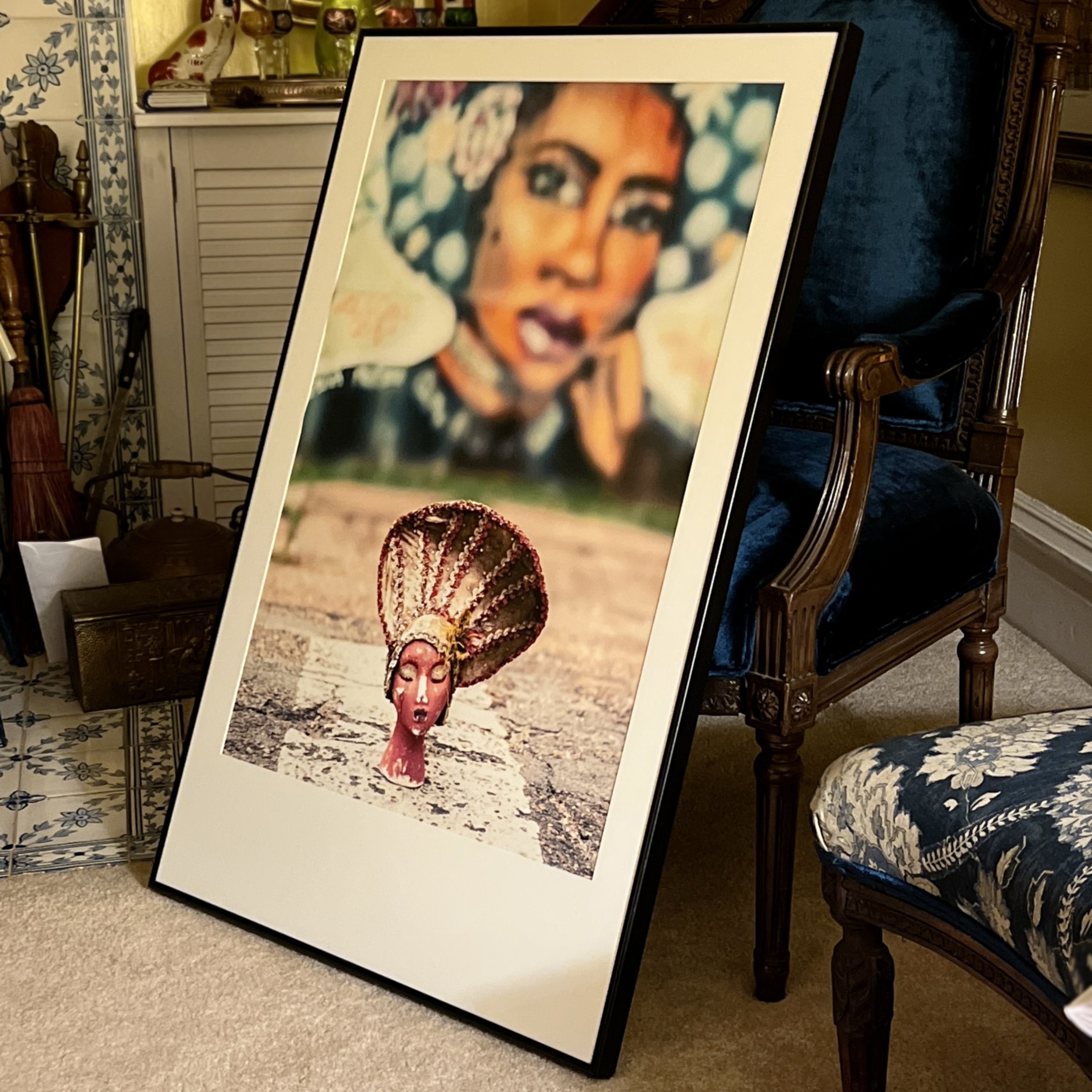
Back home again. Fine art photograph by CB Adams, created in the Marigny neighborhood of New Orleans using a handmade Mardi Gras head.

I arrived at the Angad Arts Hotel as artists were coming and going, work being delivered for the next exhibition while other pieces were being packed to go home. One artist was maneuvering an enormous canvas inside a hand-built wooden crate that filled the bed of his pickup. I admired the commitment in that scene — the scale of the work, the crate, the truck, the steady belief required to keep moving art through the world.

I was there to pick up a piece of mine from the previous show.

After around fifty exhibitions, this rhythm is familiar. A photograph leaves the studio with its own quiet energy, is seen in public for a time, and returns. The return has its own dignity. The work has been part of the world. It has gathered glances and brief moments of attention. It has lived elsewhere for a while.

This image was made during a visit to the Marigny neighborhood of New Orleans. I found a yard sale where a woman was letting go of a Mardi Gras head her mother had made in the 1960s. She spoke about it with affection and a sense of necessity. I bought it and spent the morning carrying it under my arm, making small scenes wherever the light opened an opportunity. The photograph came from that day. No thesis attached. It says something to me, and others may find their own way into it.

With time, I’ve come to understand my photography the way I imagine a theater-maker understands a production. You create the work. You offer it. People spend time with it. Then everyone goes home. The exchange has already taken place. In theater, applause marks the moment. In a gallery, it is quieter — a pause, a step closer, a longer look.

The question comes up: with everything happening in the world, does art matter? Each time I return to the studio, I find a steady yes. Art helps us remain human. It asks us to slow down. It offers a space for feeling when language is thin. It connects across experiences and across time.

So the photograph is back now. It carries a small history. And the work continues here, as it has before and will again. The seeing continues. The making continues. That feels like the essential thing.

For inquiries and viewing appointments, contact Qwerky Studio, St. Louis.

Staring At the Sons

A son.

The holidays are officially over. We finished “taking down” the decorations and packing them into the storage room this past weekend. I also processed the last roll of black and white film from the portrait sessions with my sons the week of Thanksgiving. There may be a roll or two of color candids, aka happy snaps, which I made with a point-and-shoot camera, but these are the last “serious” photographs I made. Photography was definitely part of my overall enjoyment of the holiday. As I looked at the scans this morning, the experience was different. Their eyes were upon me.

A son.

I’m taking Nietzsche’s oft-quoted phrase out of its original context and meaning, but his phrase “When you stare into the abyss, the abyss stares back” came to mind. I thought that if I looked at their portraits long enough, I would stare back at myself. Somehow. And I did. I certainly “see” myself in my sons in terms of the physical and personality. I am reminded of Chuck Palahniuk’s assertion that “Everything is a self-portrait. Everything is a diary” balanced with Richard Avedon’s aphoristic “My portraits are more about me than they are about the people I photograph.”

I hope that someday, somehow, even without me knowing it, they will stare at their own portraits and see me. “The Child,” after all, as observed by Wordsworth, “Is father of the Man”

The Clarity and Charity of Time

I am not a patient person in general and definitely not a patient photographer. This is often at odds with the analogue, film-based photography that I practice. You might think that digital would be my thing, given my impatience. But no. I have to shoot old school and then practically run to the nearest darkroom.

Like Popeye, I am what I am. Yet, I am now involved in the long process of inputting, organizing and otherwise getting my photographic shit together while enjoying my new, custom-built computer, dedicated to my photo workflow. This means I have been viewing some long-forgotten scans. It’s been, well…eye-opening. It’s like I’m seeing some of this work with new eyes. And perhaps I am.

As I revisit this old work, new images now attract my attention. I still like most of the ones that originally got my juices going, but I’m finding some gems (to me, anyway) that have just as much merit and potential. I feel like a musician who is reinterpreting an old song. I’m thinking of my favorite version of Springsteen’s Born To Run; a very slow live version, not the album version. This is also like the advice that I received (and I still pass on to my writing students) about putting your piece of writing away in a drawer and then coming back days or weeks or even months — and it’s like you’re looking at something someone else wrote. Perhaps they (you) did.

This image is a case in point. I was shooting a light-leaky Agfa Isolette camera. Most of the 15 frames are shit. But a few from this sequence spark my imagination. This was lit with 100% golden-hour sunlight right in my own backyard. I think it has a David Lynchian quality.

Maybe I was channeling Lynch’s eye.

Monochrome Pentimento by CB Adams, Qwerky Photography.

Monochrome Pentimento by CB Adams, Qwerky Photography.

This I Believe - On Artist's Statements

I’m not alone in fearing and loathing artist’s statements. I’ve written my share of la-dee-da and contrarian and tortured artiste and obtuse versions — usually at the behest of whatever exhibition or call for entry had requested or required one. I have come to realize, however, that they can and do serve a good purpose when written with the proper intent. They can be a way for others to understand, with limits, what a photographer is about, who he or she is.

My new approach to artist’s statements is to follow the guidance I received from a history professor at university. He was providing the standard by which he would be grading our term papers. “What do you mean,” he said. “And how do you know.”

I’m not going to present an artist’s statement here. I am, however, gong to say a quick something about this photo — why I like it and why I hope you appreciate it, too. I believe what “makes” this rather ubiquitous bench scene is, of course, the vines and other vegetation growing through it. For me, though, it’s the plucky branch extending from the left, like a feather boa (to this associative mind, anyway), that sets this apart from others like it. I also like the contrasting horizontal lines and patterns, and that sliver of the basement window.

So there. I said it. I made a statement. Talk amongst yourselves.

“Boa” From the Series Closer To Home by CB Adams

“Boa” From the Series Closer To Home by CB Adams