At this year’s Snob Hill Neighborhood Association Christmas party, which we hosted again because one of us happens to be the president, a neighbor made an early announcement. She wanted to review our Christmas tree.
This was not casual curiosity. She loves vintage ornaments in the way people love objects that have survived hands, houses, decades. We do not share much in common beyond geography on Snob Hill and this affection for old ornaments, but that turns out to be enough. We were happy to oblige. We enjoy a good ornament conversation, especially with a fellow aficionado. Objects can do that—create a small, sturdy bridge where shared history does not otherwise exist.
She moved slowly, deliberately, as if reading. She pointed out ornament after ornament, pausing to ask where this one came from, or how long we’d had that one. Each time, we had a story. What antique mall. Which thrift shop. Which parent’s storage bin. Which long-gone house it once lived in.
Eventually, she paused, looked at us, and said, “Boy, you have a lot of stories.”
We do, though we have never quite defined ourselves as storytellers. It is not something we announce upon meeting someone. We do not extend a hand and declare our tendencies. Still, they seem to be noticed. Many of the things in our home come with explanations, even if we rarely offer them unless invited.
This way of living with objects reminds us of Meret Oppenheim, the Surrealist artist best known for transforming ordinary things into charged, unforgettable works. In her Swiss home, objects were often accompanied by small handwritten notes, sometimes tucked discreetly inside them, explaining where they came from or how they were meant to be regarded. What might once have felt overly particular now reads as something else entirely: care made visible, memory given a place to rest.
We are far less elevated, and far less Surrealist. Still, the impulse feels familiar. To annotate. To leave leavings. To refuse to let meaning drift away.
That habit did not originate with us. Both of us had grandmothers who believed objects deserved context. They told stories of acquisition and handed-downness, of where something came from and from which branch of the family. They wrote names, dates, and notes on the backs of photographs and paintings, the bottoms of drawers, the undersides of things meant to last. We leave those markings untouched. They feel less like annotations than instructions. The only remaining father still alive between us, not in his mid-80s, has mentioned more than once recently that he’d like to sit down with a stack of photographs and a video camera running and explain who is in those photographs. We really need to take him up on that.
We share the habit our grandmothers modeled. When thrifting or antiquing, one of the first things we do is turn something over. We look at the backs of frames, the bottoms of drawers, the flyleaves of old books. One of the quiet pleasures of secondhand objects is discovering someone else’s attempt to give a something a little extra life. A penciled name. A brief explanation. A small insistence that this once mattered.
There is a lot of history captured that way. Other people’s, and eventually, our own.
We were reminded of this again when thinking about a college friend whose family was not much for keeping ephemera. What few photographs existed were claimed early by more senior relatives. Left without images, he went looking elsewhere. At tag sales and flea markets, he bought framed photographs of strangers whose faces he liked, or thought resembled him. He arranged them throughout his apartment, and later his house.
When someone commented on one, he would improvise a story about Grandfather Horace or great-aunt Audra. His lineage grew elaborate and oddly complete: Civil War and World War I veterans, gentleman farmers, dirt-poor sharecroppers, a racetrack tout and a dandy and a flaneur. It was almost entirely invented, and yet it felt authentic, even to us, who knew better. The care he took in building that history gave it weight.
There was, however, one family story he never made up, and it remained the best of them all. One of his grandfathers had been a dentist in rural Kansas who died after contracting lockjaw from working on a patient. It was stark, unadorned, and entirely true. The kind of story that needs no embellishment, and somehow made all the others feel plausible by association.
Inheritance, invention, and attention all arrive at the same place: the desire to give a life, or an object, enough context to feel anchored.
Our Christmas tree is a seasonal archive. Nothing on it arrived accidentally nor is situated haphazardly. Some ornaments came with price tags and dust. Others arrived wrapped in tissue paper that smelled faintly of basements and earlier Christmases. A few carry family names, which is a different kind of provenance altogether. Without their stories, the ornaments feel diminished. With them, they feel complete.
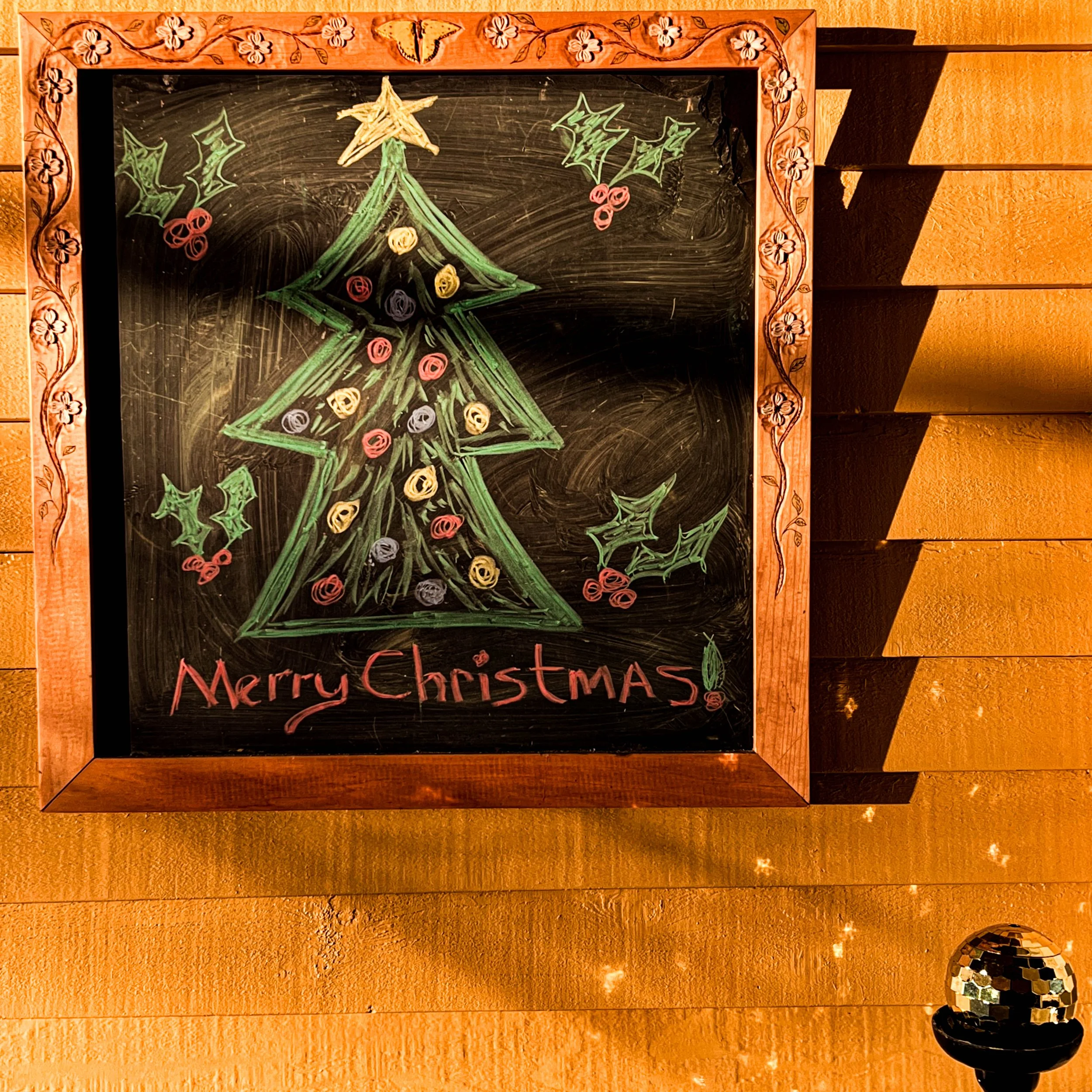
The photograph accompanying this piece shows another object that works the same way. It hangs by the front door on Snob Hill: a framed slab of slate, dark and worn, one corner still missing.
Long before it became this, it was part of a much larger sheet, rescued from a schoolhouse being demolished to make way for a new one. One of our fathers was a surveyor at the time. He saved the slate and carried it with him for decades, house to house. It was heavy, awkward, and not especially useful, but it had a past, and that seemed reason enough.
Years later, he figured out how to cut the slate into smaller pieces. For one of our mothers, he hand-carved a wooden frame so it could hang by the back door. A piece of chalk was tied to a string. Visitors could leave messages.
They rarely did. There were not many visitors, and most did not take advantage of the invitation. Still, that mother lived in hope of a steady stream of arrivals, provided they were close family. Everyone else was met with a careful reserve. The slate waited patiently either way.
A nephew once expressed a more-than-passing interest in inheriting it, but first-born, or at least uncle, privileges prevailed. Now it hangs by our front door instead. One of us changes the chalk drawings with the seasons. The slate accepts whatever is written onto it.
It also reminds us of a book we loved mostly for the poetic cadence, lilt and alliteration of its title: Best Recipes from the Backs of Boxes, Bottles, Cans, and Jars. The appeal was never culinary innovation so much as accumulation. Knowledge passed along in margins and packaging, where real life tends to happen.
“Every something tells a story” is not a declaration so much as a practice. A way of moving through rooms, objects, and seasons with attention. A habit of looking at the backs and bottoms of things, and leaving what you find there intact.
The neighbor eventually finished her review. The tree passed inspection. Glasses were refilled. Conversations drifted.
But the remark lingered — You have a lot of stories.
Yes, we do. And we don’t even have to make them up.