Family, Tradition, and the Light We Choose
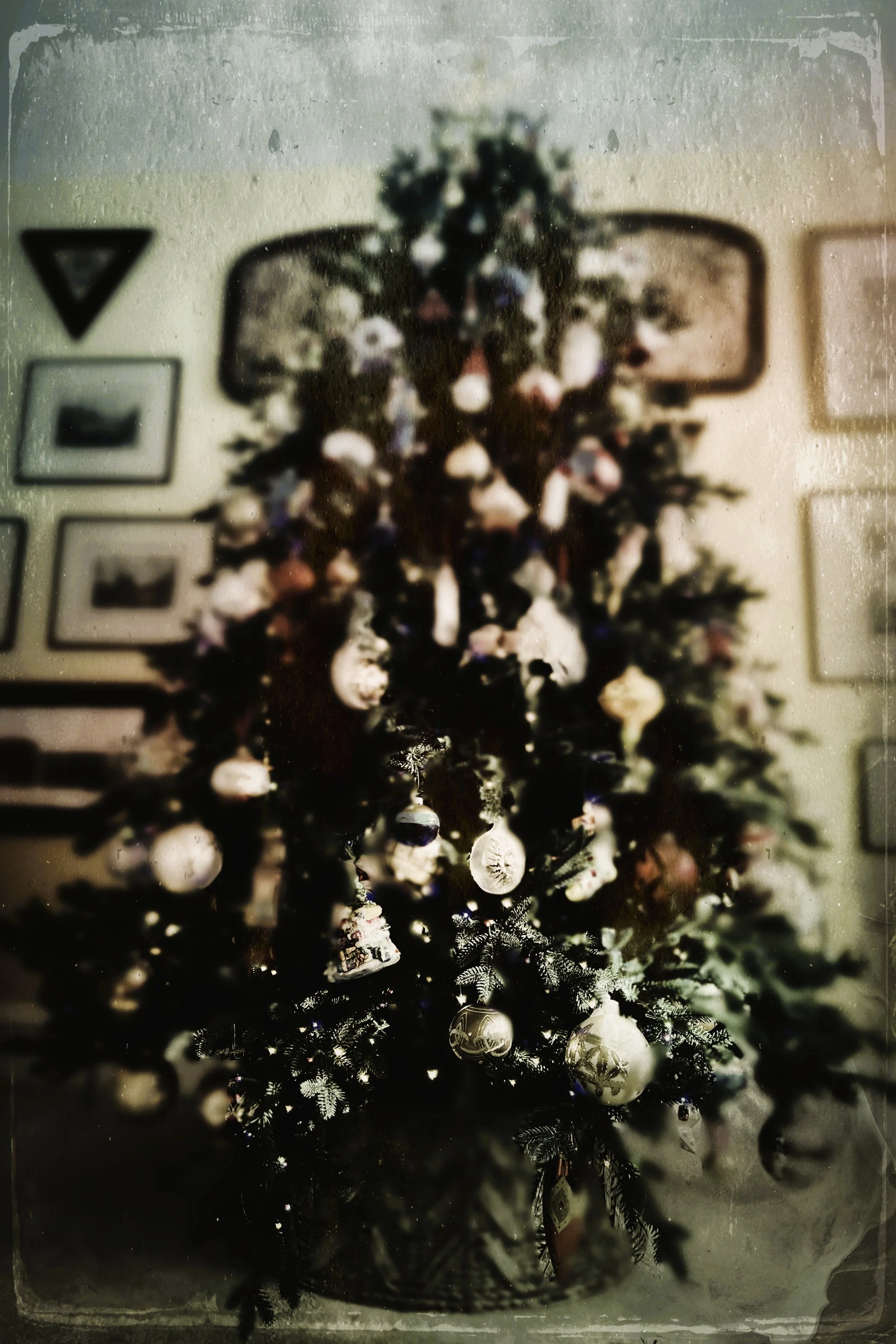
A mother found the tree farm in a short newspaper clipping. We wish we still had it — burnished, oxidized to that amber yellow newsprint gets with time — because it feels like the true beginning of the story. What was it that caught her eye? The promise of something more real than the Optimist Club tree lot? Something sturdier, truer, than the silver tinsel tree her own mother had put up since the 1950s? Did she have any inkling of what it would become? We wish we could travel back to that quiet moment when she read it, when imagination flickered before tradition hardened. That lost clipping has become its own kind of artifact — the precursor, the preamble, the forward.
From that clipping grew what we would come to call The Tradition, as these things do — gradually, quietly, until one day it felt fixed in the calendar. The Friday or Saturday after Thanksgiving meant a trip to the farm. It arrived as reliably as turkey leftovers crowding the refrigerator, as predictably as the light thinning out by late afternoon. Year by year, the ritual settled in, not with ceremony but repetition, until it became mistaken for permanence.
But enough reverie. We’re here to talk trees.
The farm itself felt timeless — a gravel road winding toward fields of Scotch pines, the wheezy tractor pulling a flatbed wagon lined with hay bales, the smell of sap and wet mittens in the air. It began modestly, almost accidentally, a side project started by an aerospace engineer who lived in St. Louis and grew trees on family land near Hermann, Missouri. The first time the family trekked out, in the late 1970s, it was only the second or third year they offered cut-your-own trees. There was a rough hayride into the fields, bow saws waiting in a wooden stand, and the sense — real or imagined — that you were participating in something elemental.
Over the decades, the farm grew. It added photos on Santa’s lap, a made in China gift shop, kettle corn, hot chocolate dispensed from those large cafeteria urns with spigots — powdered, unmistakably — and parking that eventually rivaled an NFL tailgate on a steep hill. It became crowded. It became a place where you might see people you carefully avoided the rest of the year, including the family from across the street, the Wittenbergs — nicknamed, unkindly, the Whitney Butts. Still, we went. Because it was Tradition.
One of the memories we still tell — and retell — is the rainy-year wagon story. The field had turned to pudding from days of drizzle. As soon as the wheezy tractor arrived, we clambered aboard. Across from us sat an entire family, growing in size with each retelling — sometimes five or six kids, sometimes a Cheaper by the Dozen brood, depending on the storyteller’s flair that year.
The father looked like he’d just stepped down from a deer blind. The mother was part church-lady, part Minnie Pearl, part Capote’s Sook — a composite character whose wardrobe grew more plaid and more threadbare with each telling. Their children were dressed spectacularly wrong for the cold rain — sometimes white patent-leather shoes, sometimes thin sweaters, sometimes, in the more embellished versions, flip flops. Memory is a slippery, generous accomplice. “No, no,” someone always insists, “you’ve got it wrong — they were wearing Converse.” Then the echo: “Wait — wasn’t there a baby in a bonnet?”
But the moment we all agree on is when the mother stood tall at the end of the wagon bed and hollered, “Hey!” Her children froze, turned in unison, and looked up at her expectantly. “Now spread out and look for a tree!” she commanded — as if the thousand trees surrounding us were hiding. The kids scattered instantly, toward the hills, toward the mud, toward everything. A moment of pure, chaotic Americana.
There were harder moments, too. One year, early in the age of The Tradition, our father had hernia surgery and was ordered to stay behind at the barn so he wouldn’t tear his sutures. There’s a photograph from that day — him bundled against the cold, pale, watching us ride away. It still undoes us. He wanted desperately to be with us.
Twenty years later, our mother stood in that same barn door with that same forlorn posture. Another cold, damp, bone-aching day — the kind that far outnumbered the storybook snowy ones. Lupus and fibromyalgia made the trip unbearable, but she still came, wanting to be part of it even if she couldn’t tromp through the fields. There is no photograph of her standing there — though in memory it feels like there should be — but the image is just as sharp: her shoulders tucked slightly inward, watching us head off again. Echoes upon echoes.
The farm changed. We changed. The family changed.
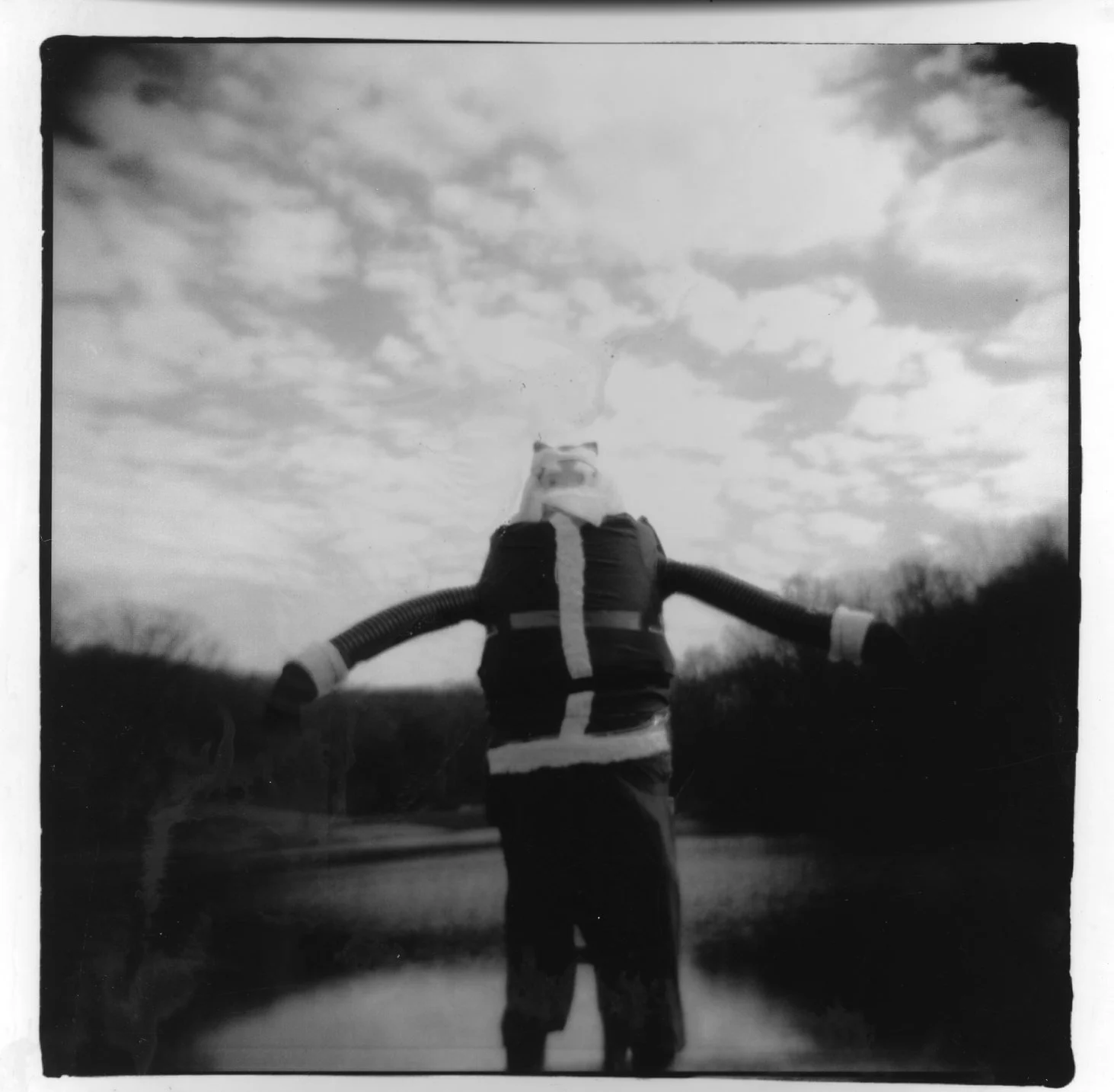
We should have known the end was nigh for a real tree (we can’t bring ourselves to call a cut tree a “live” tree) when this scarecrow Santa greeted us from atop a hill at the OG tree farm. We memorialized the scene with a Holga camera to make this photograph.
There came the year of the blight. Unable to harvest enough ready trees, the farm trucked them in from out of state and stuck them into holes like cut flowers returning to the earth in disguise. Around that time we had read The Overstory and The Secret Life of Trees, so naturally we imagined the rooted trees gossiping about the impostors. Even the evergreens, it seemed, were judging us.
And yes, for a long while, our tree was real. Fragrant. Messy. And always followed by raging sinus infections that turned December into an endurance sport. We held on longer than was sensible because traditions dare you to. Eventually, antihistamines won the argument. We switched to artificial — not lightly, not without guilt, but with relief.
Artificial trees, for us, still earn their keep — and they earn their replacement. We have a tendency to keep things longer than we should: cars, favorite sweaters, grudges. Trees fall into the same category. We limped along for years telling ourselves, We can probably get one more year out of this one, a phrase elastic enough to stretch across four or five Christmases. Every January, during the annual ritual of De-Christmasing, we said, It’s time, then packed it back into its box and shoved it into the basement. Each December we grumbled anew, until last year, when we took it to the curb before sentiment could intervene. The old tree had crossed the line. It had grown openly hostile. It drew blood. Out it went.
One of us finally reached the point where we couldn’t keep living in the weirdness of it all. Not hypocrisy. Not travesty. Just weird. Weird to go to a tree farm and not get a tree. Weird to cheer “timber” for someone else’s. Weird to interrupt our own family’s rhythms for a ritual that had become more memory than meaning. We hung in as long as we could. Then came the switch — a new, better-reviewed, more “Instagrammable” tree farm, discovered by a sister who trusts Yelp with the confidence of a medieval pilgrim following relics. It was closer to her house, of course, and shinier, and felt like a glossy New Coke version of the original. That sealed the Tradition’s fate for us.
Still, every year, that mother invited us anyway, always adding, “Are you sure?” If there is a regret — and of course there is — it arrives the way certain songs do. One line from Sinatra’s “My Way.” “Regrets, I’ve had a few…” And the box opens.
Let us pause, briefly, for a pivot into the irony sphere — where good intentions meet capitalism and everyone politely pretends not to notice. We were raised on “A Charlie Brown Christmas” (1965!), imprinted early with Lucy’s pronouncement about the big commercial racket. Layered onto that is Clark Griswold stomping through the woods proclaiming, “I give you the Griswold family Christmas tree!” as heavenly light beams down. So what were we doing at a tree farm if not paying for a curated reenactment of authenticity? The longing is perennial. The retail is, too.
After a few years of that awkward transition — when we were faintly ashamed of having gone artificial yet still dutifully piled into cars to traipse out to the tree farm — something shifted. At the time, it felt like penance: participating in a ritual whose outcome we had already outsourced. But distance clarified things. Families like ours are no longer bound quite so tightly. The nuclear family has been quietly dismantled. Instead of bundling together on a hay-bale-lined wagon, we now conduct the search more or less alone — tromping through websites, interrogating search engines, comparing dimensions and lumen counts, arranging pickup and transport ourselves. There is still care. Still deliberation. Still the serious business of choosing the tree — or at least the one that makes sense for our ceilings and for the crates and barrels of ornaments waiting their turn. The same instinct, expressed through different materials. The same, but different.
Which brings us to this year’s debate — not whether to buy an artificial tree, but what kind. Pre-lit or not. Eight feet or nine. Height versus girth, which turns out not to be a metaphor but a genuine point of contention. One of us argues for vertical ambition — high ceilings demand a tree that understands proportion. The other insists that fullness matters more, that girth carries the visual weight, that a tall, skinny tree is just showing off. Cost, of course, lurks behind every aesthetic argument, pretending not to listen while taking notes.
Then there is the matter of light. One of us believes the magic lives there — that ornaments only become themselves when properly illuminated. The other maintains that ornaments should stand on their own, that a tree shouldn’t need theatrical lighting to make its case. This disagreement has persisted for decades and has resulted in trees wrapped, unwrapped, and rewrapped with the care of a long-running détente. Visitors always comment on the results, asking how we do it. When we explain, they usually throw up their hands and say, “That’s too much work.”
Well, yeah… And your point is?
Pre-lit trees complicate everything. For years we avoided them — early-adopter tax, questionable longevity, insufficient candlepower. Eight hundred lights for an entire tree? One of us could burn through that on the lower branches alone. LEDs helped. Prices came down. Technology matured. Still, we hesitate. There’s something suspect about outsourcing the glow. And yet here we are, considering it, because even resistance evolves.
We are wary, too, of letting the purchase itself become a symbolic act. The C-word lurks here — commercialization. December runs on buying, on the idea that meaning can be rung up at the register. We dip in. We taste. We hope not too much.
And yet the desire persists. Long before LEDs, people clipped candles to trees just to make them glow — a risk we can admire if not replicate. Perhaps the next iteration will be holographic, AI-assisted trees that bloom from a small box when you walk in the door, reading your mood and deciding what kind of glow you need. That will have its charms — Star Trek holodeck charms — but something will be lost, the way a frozen turkey dinner gestures vaguely at Thanksgiving.
We suppose we could not write about Christmas trees — holiday trees, Hanukkah bushes, whatever evergreen proxy gets you through December — without at least acknowledging the music that insists on accompanying them. We have tried, valiantly, to avoid “O Tannenbaum.” We should like it more than we do. Even Aretha Franklin belting it out with operatic conviction couldn’t quite salvage it. John Denver’s “Alfie, the Christmas Tree” means well but infantilizes the tree, no matter the cultivar. We do have a soft spot, though, for “Little Fir Tree” from the Captain Kangaroo Christmas album — nostalgia doing most of the work, which is probably the point.
In more recent years, we’ve found ourselves unexpectedly fond of Cyndi Lauper’s “Early Christmas Morning,” less for its lyrics than for its Cajun lilt and loose-limbed warmth. “Listen to the children sing / Watch them dancing all ’round the Christmas tree…” she urges. That part never quite applied in our house. With our two sons, there was no dancing — one a bit of a Peter Pan, the other more of an Eeyore — and certainly no patient circling. Dancing would have interfered with the main event. Gift opening was never so much opening as it was a Christmas spasm of tearing and shouting: ripping, shredding, paper everywhere, joy expressed at full, sugar-fueled velocity, choreography be damned.
When we think about the Christmas tree, we are thinking less about the lighting schemes or ornament choreography — topics for other days — and more about the tree itself. Real or trying to be real. Unadorned, at first. The tree represents one of the dualities we love about the season: the public bustle of December and the quieter work at home. The decking of halls. The once-a-year tea blends brewed carefully and poured into vintage china that emerges only now.
This is where the tree comes in. We become its tailors. We bring in this green stranger and assess it — size, girth, limbs — as if we haven’t done this countless times before (with artificial trees, we somehow forget, and that forgetting feels like a gift). We decide where it will stand, what it will hold, how it will inhabit the room. We are inviting something unfamiliar into our home and asking it to celebrate with us.
That, more than anything, may be why the tree — real or not — endures. Not as symbol or spectacle, but as companion. A participant. A reminder, standing patiently, that amid all the noise and commerce and motion, we still make room for something green, something hopeful, something that insists, gently, on being present.
Oh, Christmas tree, indeed…
Coda — After the Lights Are On
And so the tree we chose — carefully, argued over, justified — now stands where it was always meant to stand. It emerged from its box without drama. The pre-lit worked immediately, which still feels faintly miraculous. The remote behaved. The tree topper, also remote-enabled (a detail we would once have mocked and now accept with measured gratitude), clicked on as instructed. Three brightness settings. White or multicolored, at will. No dark patches. No muttering. No blood drawn. In the brightness department, it does not disappoint.
After the initial lighting and decorating rituals — the unpacking of ornaments, the small negotiations, the rediscovery of things we forgot we owned — we settle in. Not for a long winter’s nap, but for a short season. In recent years, we’ve grown more aware of how brief December really is. The days are short, literally and otherwise. The light arrives late and leaves early. The season moves faster than it used to, no matter how much we dress it up.
When we pass a car on the road with a tree strapped to the roof — netted tight, trunk facing forward, children visible in the backseat — we smile. We recognize the scene instantly. We know where they’ve been. We know what comes next. We send them good cheer, silently, without irony. Their tradition is no longer ours, but it is familiar. It is ongoing.
Our tree stands quietly now, doing what trees have always done for us this time of year: holding light, marking time, bearing witness. Real or artificial, complicated or not, it participates. And for this brief stretch of December, that feels like enough.